
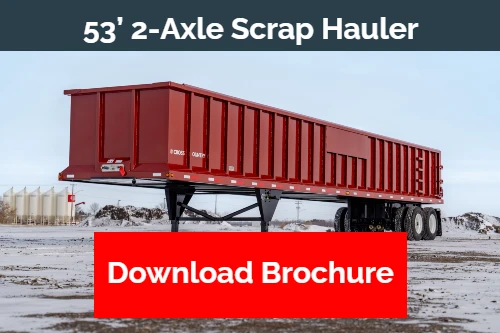
Demolition debris, sheared I-beams, crushed car bodies, and engine blocks represent the most abusive materials hauled on North American highways. Here is how trailer steel selection impacts longevity.
The Economics of Scrap Hauling: Tare Weight vs Impact Longevity
In scrap and demolition hauling, trailer profitability depends on two opposing factors: 1. **Tare Weight:** Every pound saved in empty trailer weight is an extra pound of revenue-generating payload. 2. **Impact Durability:** Dropping a 2,000-lb scrap engine block into a thin trailer tub causes dishing, punctures, and expensive downtime.
The Advantage of Hardox® Wear Plate
Standard mild steel (such as A36) has a yield strength of approximately 36,000 PSI. Under heavy scrap impact, mild steel permanently deforms, creating dents and ripples that trap material during dumping.
Cross Country Manufacturing builds its demolition and scrap trailers using genuine SSAB **Hardox® 450** and **Hardox® 500 Tuf**: - **Extreme Hardness (450–500 HBW):** Resists abrasive wear from jagged scrap edges and concrete rubble. - **High Yield Strength (175,000+ PSI):** Over 4 times stronger than mild steel, allowing thinner plates that absorb impact without permanent plastic deformation. - **Payload Gain:** By utilizing high-strength wear plates, tare weight is reduced by up to 2,500 lbs compared to traditional reinforced mild steel trailers, translating directly into thousands of dollars in extra payload each season.
Reinforced Top Rails & Tailgate Latches
In scrap yards, grapple loaders frequently contact the top rail of the trailer during loading. Cross Country incorporates high-strength structural box-section top rails and heavy-duty over-center air tailgate locks to prevent frame splay and gate blowout under dynamic load shifts.