
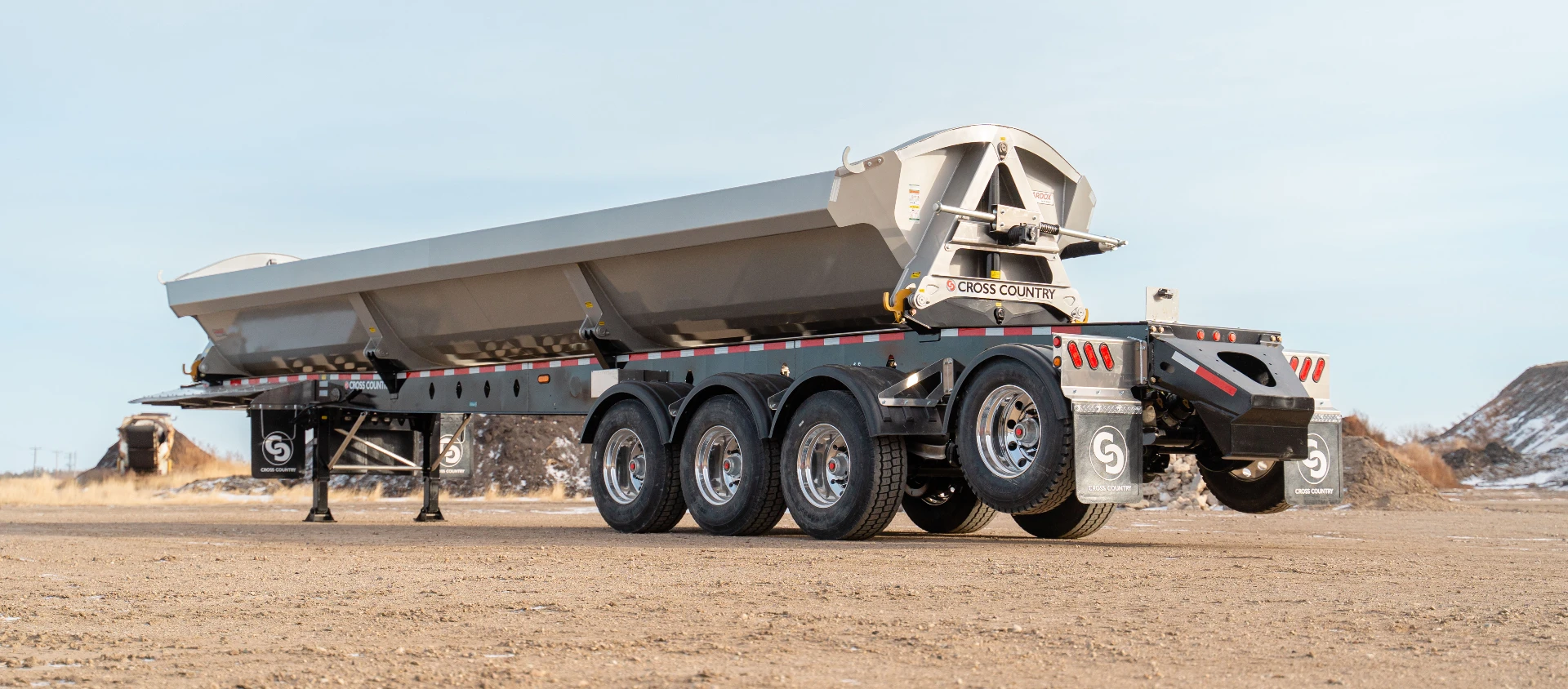
When choosing between a side dump and an end dump trailer, the decision often comes down to job site terrain, tip-over risk, cycle speeds, and material discharge requirements. Here is an in-depth breakdown.
The Core Differences: Side Dump vs End Dump
For earthmoving, aggregate hauling, and heavy construction, both side dumps and end dumps remain staple equipment. However, operational conditions dictate which trailer delivers lower total cost per ton moved.
1. Unloading Stability & Tip-Over Risk
The most significant operational difference is tip-over vulnerability:
- **End Dump Trailers:** As an end dump raises its box, its center of gravity moves up and back dramatically. On soft shoulders, uneven fills, or during high-wind conditions, tip-overs remain a known hazard in the earthmoving industry.
- **Side Dump Trailers:** Cross Country Manufacturing SDX side dumps maintain their primary wheels on the ground throughout the discharge cycle. Because the tub pivots along its longitudinal axis rather than tilting skyward, the center of gravity remains low. A side dump can safely discharge while on grades that would be hazardous for an end dump.
2. Discharge Speed & Windrow Placement
- **End Dumps** require a dedicated turnaround area and a flat backing trajectory to pile material against a hopper or berm.
- **Side Dumps** allow continuous rolling discharge. An operator can drive along a road shoulder or ditch line and deposit a clean, uniform windrow without stopping, significantly accelerating cycle times on highway paving and embankment projects.
3. Payload and Tub Volume
End dumps generally hold the edge in raw volumetric capacity for lightweight materials. However, modern side dumps fabricated from high-strength steels like Strenx® and Hardox® achieve competitive tare weights, allowing maximum legal payloads of dense aggregates, rip rap, and shot rock without structural deformation.
Conclusion & Recommendation
Choose a **Side Dump** if: - You frequently discharge on uneven, uncompacted, or roadside fill. - You need to lay continuous windrows while moving. - You handle boulders, broken concrete, or heavy shot rock that could dent or hang up in traditional end dump gates.
Choose an **End Dump** if: - You discharge primarily into fixed hoppers or paving machines. - You require maximum cubic yard volume for lighter materials.